Deye Inverter F55 (DC-Volt High-Fault) Practical Analysis
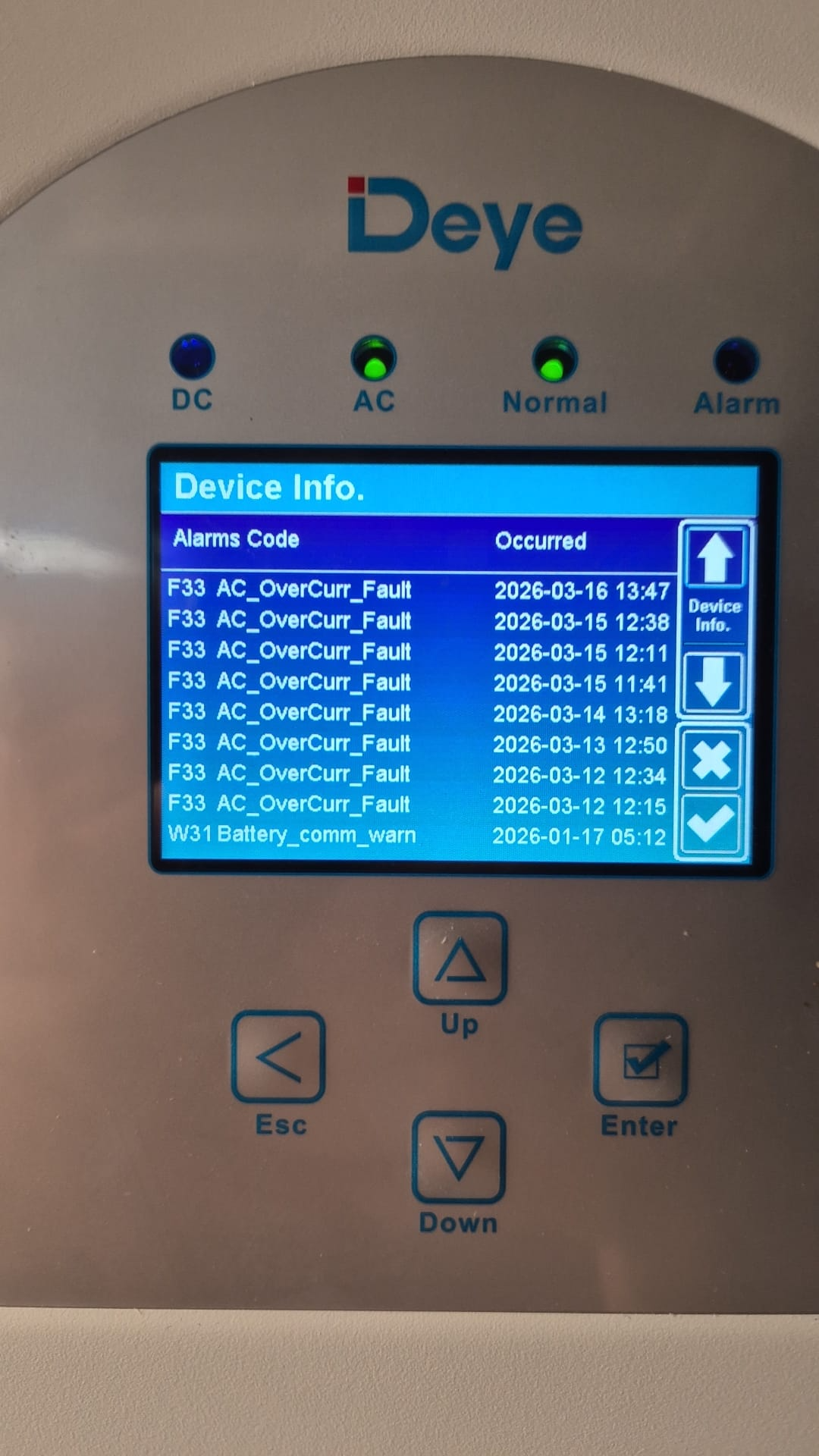
Mar 28,2026F33 Is Not Always a "False Alarm": Why Phase Current, AC Coupling and Transient Loads Matter
Mar 27,2026Which Household Appliances Can Be Connected to a Solar Power System?
Mar 27,2026Occitanie Photovoltaic Subsidies 2026 | Uniz Solar
Mar 22,2026Deye SE F5 Pro-C|Your Trusted Low-Voltage Home Battery
Mar 21,2026F33 Is Not Always a "False Alarm": Why Phase Current, AC Coupling and Transient Loads Matter
When an inverter reports an AC overcurrent event but the site appears normal a few minutes later, the instinct is often to suspect a nuisance trip. In practice, the better starting point is usually simpler: read the phases, check where the AC-coupled inverter is connected, and ask what changed immediately before the alarm.
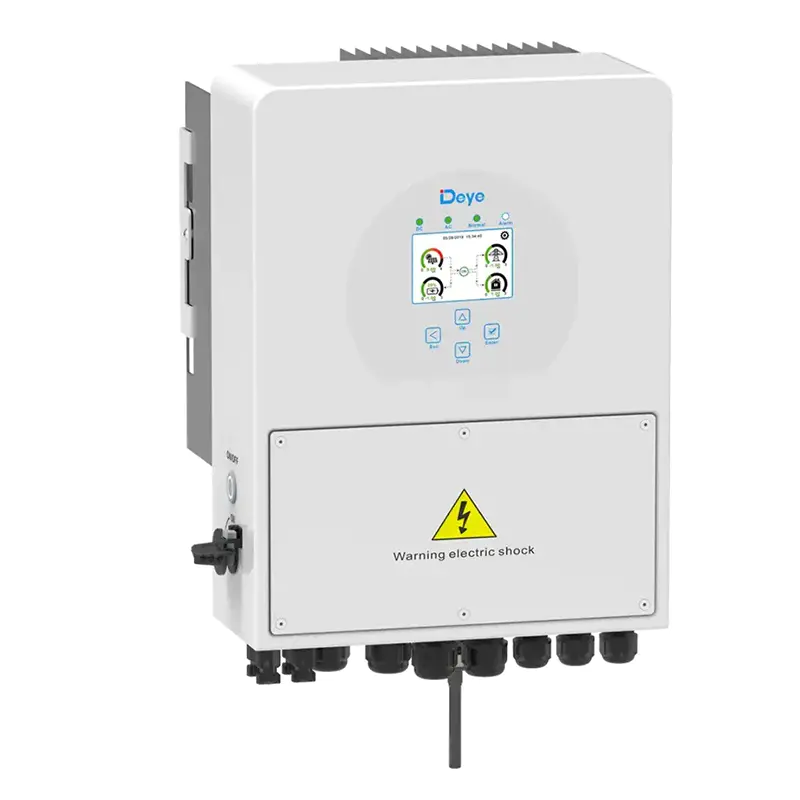
Field service rarely rewards the quickest assumption. An alarm that seems mysterious at first glance often turns out to be ordinary once the electrical path is understood. F33 sits squarely in that category. On some Deye hybrid inverter families, the code is listed as AC_OverCurr_Fault. On other families, the numbering shifts slightly, but the practical lesson is much the same: begin with the AC side before concluding that the machine has misreported the event.
That distinction matters, because an AC overcurrent event is often interpreted too narrowly. Installers may look at total site power, take a steady-state current reading, see nothing dramatic, and decide the alarm cannot be real. Yet current does not always behave in the tidy, evenly balanced way a headline power figure suggests. A site can look modest in total kilowatts and still place a meaningful burden on one phase, particularly where AC coupling, backup loads, or short-lived switching events are involved.

Start with the code, but do not stop there
The first useful point is a sober one. Fault code numbering can vary by inverter family, so a service team should always confirm the exact model before treating any single code as universal. Even so, Deye's own manuals point in a consistent direction: when the inverter flags an AC-side overcurrent condition, the investigation should begin with current on the AC path, not with a hurried conclusion that the battery, the BMS, or the PV input must be to blame.
That may sound obvious, but it is where many conversations go astray. Once a battery looks healthy in historical data, attention often shifts to software or firmware. Sometimes that is justified. More often, the basics still have not been checked properly: where the current was flowing, on which phase it was concentrated, and whether the system configuration made that concentration more likely.
|
Model note This article uses F33 in the sense found in Deye manuals where F33 is designated as an AC overcurrent fault. On some other product families, the equivalent AC-side alarm may appear under a nearby code number. The diagnostic logic remains broadly the same. |
Why a later zero-current reading proves very little
A common field objection sounds reassuring, but it is not conclusive: "We checked the current when the alarm was discussed and it was zero." That tells us only what the site looked like at that later moment. It does not tell us what happened when the event was triggered.
Brief overcurrent events can come and go quickly. A compressor, pump, heater bank, charger, or another inverter can change the picture in a matter of seconds. If the condition disappears before a technician arrives, the steady-state reading may look perfectly harmless. Historical curves can also miss the most revealing detail because the event may be shorter than the logging interval or may be smoothed into a broader trend that looks unremarkable in hindsight.
This is why context matters. A service report becomes far more useful when it records what switched on, what mode the system was in, whether the site was grid-connected or working through the load side, and whether the event coincided with a known change in demand.
The 5 kW misunderstanding: total power and phase current are not the same thing
One line from the field comes up again and again: "The load is limited to 5 kW, and 5 kW does not produce 22 A." That statement is only true under a particular assumption, namely that the power is shared evenly across a three-phase system. Once the load or the AC-coupled source is concentrated on a single 230 V phase, the arithmetic changes at once.
|
Scenario |
Power basis |
Approximate current |
|
5 kW concentrated on one 230 V phase |
Single-phase |
21.7 A |
|
5 kW shared across 400 V three-phase supply |
Balanced 3-phase |
7.2 A per phase |
So the more accurate statement is this: 5 kW will not normally give 22 A on each phase of a balanced three-phase system, but it can certainly sit in that range on one 230 V phase. That is precisely why phase-level data matters. A site can be within expectation in aggregate and still push one conductor much harder than the total power figure suggests.
The point is not that every 22 A reading is acceptable. It is that the number itself should not be dismissed as impossible without first establishing how the power is distributed. In a real installation, an AC-coupled string inverter on L1, or a large load concentrated on L1, can make the phase current far more important than the headline kW number.
Why the AC-coupling location matters
Deye's European hybrid inverter documentation makes an important point that is easy to overlook in day-to-day troubleshooting: AC coupling may be configured on the grid side or on the load side, and on supported models the GEN port can also be used as a Micro Inv Input. That flexibility is useful, especially when retrofitting an existing solar system, but it also changes how power moves through the installation and how alarms should be interpreted.
If an on-grid inverter is AC-coupled on the load side, the discussion should immediately shift from total site generation to the path that power is taking through the backup output and the phases connected to it. Equally, when an external meter is used for AC-coupled monitoring, Deye's manuals note that the meter data needs to communicate correctly with the hybrid inverter in order for load consumption data to be accurate. Without that context, technicians and customers can end up arguing over screenshots rather than diagnosing the real electrical condition.
Read the phases, not just the total
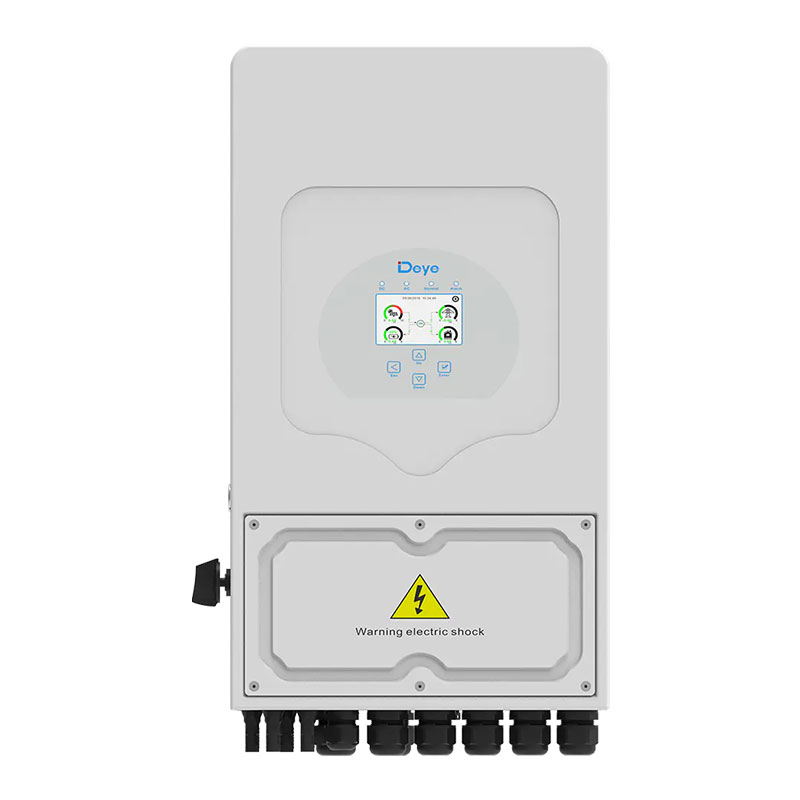
This is where the inverter's own detail pages are often more revealing than a single total-power view. Deye's interface presents voltage, current and power for each phase on the inverter side, and voltage and power for each phase on the load side. For a service team, that is not decoration. It is often the decisive clue.
Three-phase systems can still be uneven. Deye's datasheets for low-voltage three-phase hybrids state that the inverter supports unbalanced output, and the menus on recent models also refer to asymmetric phase feeding. In other words, the system is built to work in the real world, where loads do not always divide themselves neatly. But that same reality means troubleshooting has to be done at phase level. A flat total figure can hide a lopsided installation.
|
A practical field sequence before blaming the hardware 1. Confirm the exact inverter model and fault-code family. 2. Verify whether the AC-coupled inverter is on the grid side or the load side, and record which phase it is connected to. 3. Read voltage, current and power by phase at the inverter, not only total site power. 4. Reconstruct the moment of the alarm: what load started, what mode the system was in, and whether a transfer or switching event took place. 5. Check meter or CT wiring and communication where AC-coupled monitoring is part of the system design. 6. Only after those steps should the case move toward hardware replacement, firmware escalation or factory-level analysis. |
A better way to explain F33 to customers
Customers do not usually want a lesson in fault-code philosophy. They want to know whether the inverter is safe, whether the system is wired correctly, and whether they are being asked to replace parts unnecessarily. The most useful answer is not to say that the alarm was definitely right or definitely wrong. It is to explain that an AC overcurrent event must be judged from the actual current path, the actual phase loading and the actual operating moment, not from a calm snapshot taken afterwards.
That makes for a better service conversation. It shows that the investigation is grounded in electrical behaviour rather than guesswork. It also avoids two extremes that both damage trust: dismissing the alarm as a software glitch without evidence, or treating every overcurrent code as proof of a hardware defect.
In the end, many F33 discussions are not about a mysterious inverter at all. They are about the gap between aggregate power and phase current, between steady-state readings and short-lived events, and between a neat single-line diagram and the way the installation is actually connected on site. Close that gap, and the case usually becomes much easier to understand.
←
Deye Inverter F55 (DC-Volt High-Fault) Practical Analysis
→
Deye SE F5 Pro-C|Your Trusted Low-Voltage Home Battery
+31610999937
[email protected]
De Werf 11, 2544 EH The Hague, The Nederland.
WhatsApp: +1 (917) 257 2995/Copyright © 2023 Uni Z International B.V. VAT: NL864303440B01 All Rights Reserved
Solar Energy Storage System Solutions and Products